
Marketing That Moves Minds: Behind the GPPC2025 Conference Success
From speaker spotlights to live updates, WIP Digital Marketing captured every moment of GPPC2025. Explore the posts, campaigns, and creative behind the scenes of this landmark event.
How We Kicked Off GPPC2025 With Standards That Shape The Future
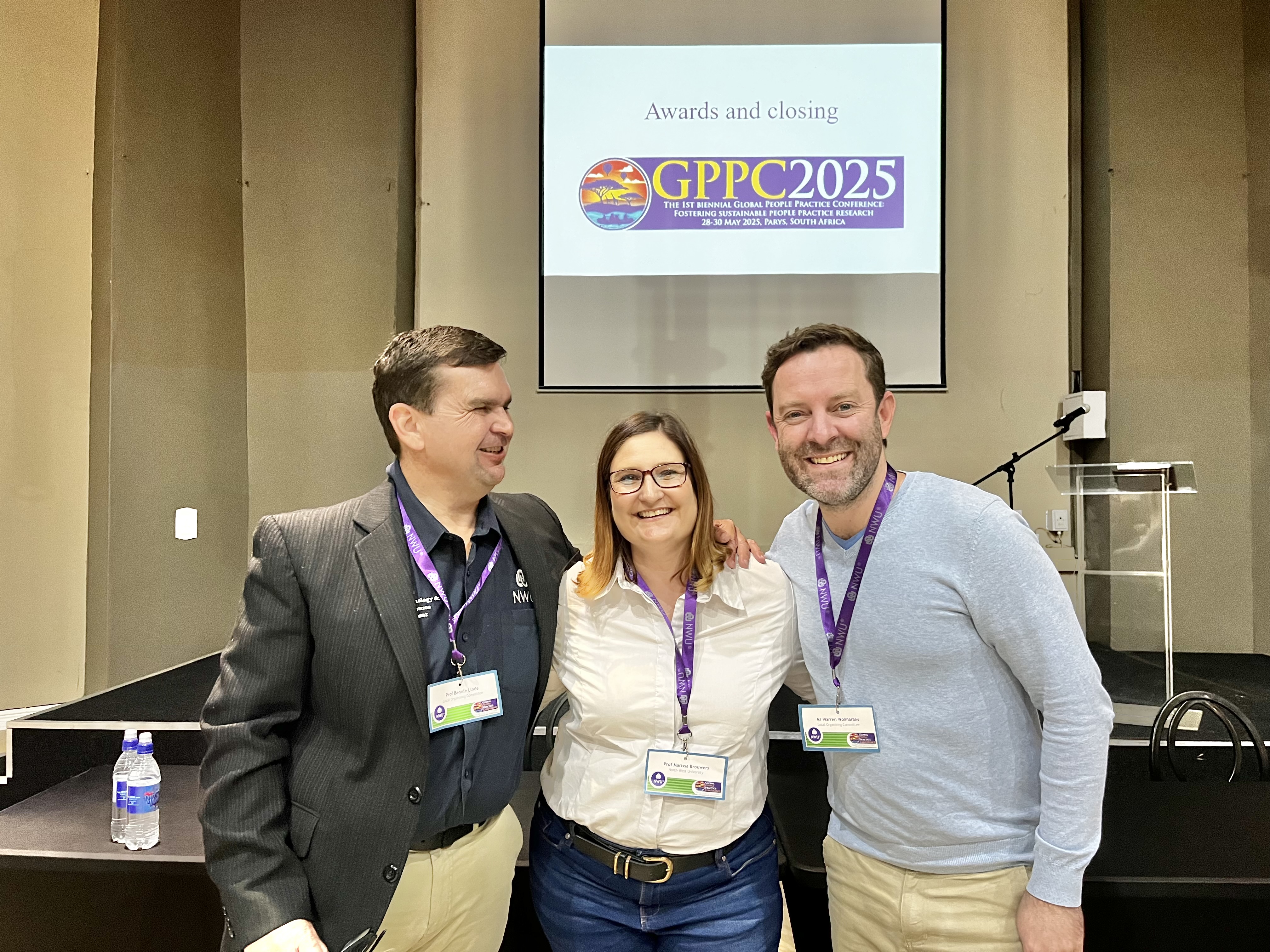
Our first session at GPPC2025 opened with warm welcomes from Prof Marissa Brouwers, Prof Bennie Linde (Chair of the Local Organising Committee), and Prof Bouwer Jonker, who introduced our opening keynote speaker, Dr Ajay Jivan.
Dr Jivan set the tone for the week with his keynote:
“Standards for Global People Practices: A South African Perspective on Setting Standards and Systematising Practice.”
Key insights included:
🔹 The importance of standardisation and systemisation in HRM
🔹 Navigating the difference between good, best, and evidence-based practices
🔹 Exploring the role of system configurations in HR
🔹 Research opportunities linked to creating consistent, meaningful standards
As a representative of SABPP, Dr Jivan highlighted the collaborative role of academics and practitioners in shaping functional and technical HR standards - and building a shared language for the profession.
This is just the beginning. Join us as we continue to explore the evolving world of people practices.
🎓 Professional Development in Action
Fostering Sustainable People Practice
GPPC2025 | Sessions 1 & 2
What does it take to turn workplace challenges into research-driven solutions?
This powerful two-part workshop brought together professionals, researchers, and thought leaders in HRM, HR Development, Labour Relations, and Industrial Psychology to do just that.
🔹 Session 1: Sustainable People Practice Challenges
With panellists Dr Ajay Jivan, Dr Ronel Kleynhans (De Beer) PhD Ind. Psychology, Dr Renier Els, and Ms Carina Linde, participants engaged in breakout discussions that uncovered the real issues shaping people practices today:
✅ Adaptability in the workplace
✅ Well-being and employee support
✅ Sustainability in practice
✅ Hybrid work dynamics
✅ Mistrust and culture gaps
✅ Clarity of values and leadership
✅ Transgression handling and foundational knowledge
🔹 Session 2: Fostering People Practice Research
Panel: Prof Charissa Freese, Prof Lené Graupner, Prof Cara Jonker
The themes from Session 1 were carried forward and expanded into research-oriented dialogue. The panel unpacked emerging methodologies, interdisciplinary strategies, and applied research approaches to tackle the identified challenges.
Participants then worked in breakout groups to:
📌 Explore research frameworks
📌 Collaborate across disciplines
📌 Propose actionable strategies for impact
These sessions showed that sustainable change in people practices doesn’t happen in silos - it happens when practice and research meet.
Moderated by Nicole Nagel (Pracademic)
Behind-the-scenes guidance: Prof Bennie Linde
🎓 Postgraduate and Early Academic Career Development Workshop
Held concurrently with GPPC2025 in a dedicated venue
While the main conference sessions unfolded next door, a focused and enriching space was created for the next generation of academics.
Led by Dr Neil Barnard, the Postgraduate and Early Academic Career Development Workshop brought together emerging scholars for a morning of reflection, discussion, and growth - supported by a dynamic panel of mentors: Prof Elaine Farndale, Dr Thapelo ChaaCha, Ms Debbie Mtshelwane and Prof Crizelle Els.
🧭 In Session 1, participants were challenged to consider: What is your purpose?
This powerful question sparked meaningful dialogue around academic identity, motivation, and long-term vision.
🤝 Session 2 shifted to the theme of collaboration - underscoring the importance of building strong networks, co-creating knowledge, and working across disciplines.
Students also reflected on their own journeys: Why did I choose academia?
Their responses added heart to the session and reminded us all of the passion that drives research and teaching.
This workshop stood out as a space of intention - where early career academics could find clarity, community, and inspiration.
📚 Session 3: Publishing People Practice Research
GPPC2025 | From Ideas to Impact
The final session of the day shifted focus to one of the most critical steps in the academic journey - getting published.
🗣️ During the panel discussion, leading voices in the field - Prof Elaine Farndale, Prof Bouwer Jonker, Prof René Schalk, and Prof Bennie Linde - shared practical insights on:
✅ Understanding scope and author guidelines
✅ Selecting the right journals
✅ Submission strategies and timelines
✅ Responding to peer reviews
✅ Aligning research themes with journal priorities
💡 Participants then had the rare opportunity to engage directly with journal editors, asking questions and gaining first-hand advice on how to publish meaningful, practice-driven research.
Notably, panel members also brought their editorial experience:
🔗 Prof Bennie Linde – affiliated with LitNet Akademies (https://www.litnet.co.za/)
🔗 Prof Bouwer Jonker – affiliated with Unisa Press Journals (https://lnkd.in/eAE2e-Jt)
From insight to output - GPPC2025 has laid the groundwork for research that matters.
A sincere thank you to Nicole Nagel for moderating all three sessions today.
Day 2 at GPPC2025 – Spotlight on Inclusive Labour Markets
This morning in the iBhubesi Hall, we had the honour of hearing from Prof Charissa Freese (Tilburg University / Avans University of Applied Sciences), who delivered a powerful keynote on:
“Working towards an inclusive labour market from a multidisciplinary perspective on people practices.”
Prof Freese challenged us to think beyond traditional HRM approaches by exploring how inclusion can be built across disciplines - from the individual level, through organisations, to broader policy structures.
Key reflections included:
🔍 The value of transdisciplinary research in shaping social policy
🌍 The role of SDG 8 (Decent Work and Economic Growth) in HR thinking
💼 The need to protect people, not just jobs
🔄 Labour market transitions - including gig workers, the self-employed, and those excluded from formal systems
🤝 How organisations (not just governments) are leading inclusive development initiatives
Her address also raised critical questions about strategic blind spots in HR, access to decent work, and the future role of inclusive employment in the South African context.
These are the conversations shaping people practice research – and GPPC2025 is proud to host them.
A sincere thank you to Prof Bennie Linde and Prof Marissa Brouwers for their warm welcome and thoughtful moderation throughout the morning’s sessions. We are also grateful to our conference funders - South African Tourism and WorkWell Research Unit - and our hosts at the NWU_ School of Industrial Psychology and Human Resource Management for making this gathering of global minds possible.
A special word of thanks to Prof Verona Leendertz, Deputy Dean of Research and Innovation, for sponsoring the keynote gift - your continued support of knowledge-sharing and innovation is deeply appreciated.
TRACK 1: Human Resource Development – Advancing Practice Through Research
📍 iBhubesi Hall | Convenor: Prof. Helen Meyer
Day 2 of GPPC2025 continued with powerful contributions under the Human Resource Development track, unpacking critical questions about the future of learning, skills development, and knowledge transfer in dynamic work environments.
🔹 Ms Rucresia Venacio, presenting on behalf of Prof. Abkhabue Okharedia and Dr Christiana Omolayo Kappo-Abidemi, explored the relevance of education for the future of public service in South Africa. Their case study on the provincial public sector highlighted how education systems must evolve to better serve the needs of public institutions and promote service excellence.
🔹 Dr Renier Els presented the collaborative paper with Mr Papi Sibanda titled "Exploring training managers' quality assurance functions in South Africa post-COVID-19." This study tackled the shifting responsibilities and expectations of training managers in a post-pandemic context - and how quality standards must adapt to support hybrid learning environments.
🔹 Mrs Petro Smith presented her research, co-authored with Prof. Helen Meyer, on the role of South African HRD professionals in knowledge management. The paper emphasized the growing strategic importance of HRD in capturing, organising, and transferring knowledge in fast-changing organisations.
🔹 Prof. Fabiano Pallonetto presented a global collaboration with Dr Amy Fahy, Ms Sadhbh Crean, Ms Carrie Anne Barry, and Ms Nicolene Dawkins, titled "Online engagement strategies for sustainable upskilling in SMEs."
Their work provided practical insights into how small and medium enterprises can create meaningful digital learning experiences to foster long-term employee growth.
Each paper in this session offered forward-looking, research-backed insights that enrich the ongoing conversation around sustainable HRD practices.
TRACK 2: Labour Relations - Unpacking Legal, Organisational and Human Dynamics
📍 Sundowner Boardroom | Convenor: Ms Nicole Nagel
While Track 1 explored HRD, the Sundowner Boardroom was host to a compelling Labour Relations session that tackled timely issues affecting South African workplaces today - from evolving employment law to the realities of municipal service delivery and cannabis legislation.
🔹 Dr Werner Gresse presented on behalf of Mrs Charity Malemela, Prof. Elsabe Keyser, and himself, exploring the psychological contract, job satisfaction, and turnover intention within local municipalities. The study compared standard-functioning municipalities with those under administration - highlighting the influence of organisational climate on employee loyalty and performance.
🔹 Dr Estie Gresse delivered a focused legal commentary on “The impact of private consumption of cannabis in the workplace,” drawing from the case Enever v Barloworld Equipment South Africa [2024] 6 BLLR. The paper raised essential questions on employee rights, workplace policy, and the legal implications of off-duty conduct.
🔹 Prof. Paul Smit offered an insightful critique titled “Amendments to South Africa’s Labour Relations Act: A chameleon on a box of Smarties.” His presentation explored the shifting character of labour legislation - questioning whether ongoing amendments bring clarity or further complexity to labour relations in practice.
🔹 Closing the session, Prof. Bennie Linde addressed “Defining the employment relationship as a field of study” - tracing the journey from theoretical models to their practical application in today’s workplaces. His paper underscored the need to continually rethink how employment relationships are understood in policy, law, and organisational behaviour.
This session illuminated how labour relations in South Africa are being reshaped by both legal rulings and shifting workplace norms - a must-follow conversation for practitioners and researchers alike.
TRACK 3: Human Resource Development – Future Skills, Climate Change & Talent Retention
📍 iBhubesi Hall | Convenor: Dr Renier Els
The afternoon session of Day 2 at GPPC2025 continued to deepen the conversation around Human Resource Development, with a strong focus on sustainability, skills for the future, and urgent workforce challenges in the healthcare sector.
🔹 Ms Maletsoela Alina Mahao, presenting on behalf of herself and Dr Mildred Mahapa, delivered an important paper titled “Climate change and the world of work: The role of HR.” This research explored how climate adaptation and environmental responsibility are becoming essential considerations for HR practitioners, particularly in supporting just transitions and integrating green principles into workforce strategies.
🔹 Mr Caleb-John Wood presented his research on “Effective talent management practices in retaining emergency medical professionals in the Eastern Cape.” This study addressed one of South Africa’s most pressing HR challenges - the retention of critical healthcare staff - and highlighted practical interventions that can strengthen employee commitment and reduce turnover in high-pressure environments.
🔹 Dr Amy Fahy concluded the session with her paper on “Transformative learning and micro-credentials: Promoting the development of future work skills for an inclusive green economy transition.” Her research illustrated how micro-learning and targeted upskilling can equip workers for green jobs and ensure no one is left behind in the evolving labour market.
This session highlighted how Human Resource Development is not just about training - it's about preparing people and systems for the future of work in all its complexity.
TRACK 4: Labour Relations – Well-being, Citizenship, and Coaching in the Modern Workplace
📍 Sundowner Boardroom | Convenor: Prof. Paul Smit
The final session of Day 2 at GPPC2025 focused on strengthening the human dimension of labour relations - from flexibility in care work to the psychology of employee behaviour and developmental support for HR practitioners.
🔹 A systematic review by Mr Ryan Bartlett, Dr Werner Gresse, and Prof. Elsabe Keyser examined workplace flexibility, employee well-being, and work-life balance among early childhood development practitioners and managers. Their research highlighted the critical role of flexible policies in supporting retention and emotional resilience within this essential sector.
🔹 Ms Nicole Nagel and Prof. Bennie Linde contributed a pilot study titled “Measuring the link between employee citizenship and the psychological contract.” Their work explored how trust, expectations, and perceived obligations between employees and employers shape proactive workplace behaviours.
🔹 The session concluded with research by Mrs Roslyn Lodewyk-Raliphada and Prof. Lené Graupner on “The evaluation of a strength-based coaching skills training programme for HR practitioners.” The study emphasised how focusing on individual strengths can improve coaching effectiveness and promote long-term professional growth in HR roles.
This session reaffirmed the need for adaptive, values-driven approaches in modern labour relations - where well-being, trust, and personal development are at the centre.
🌍 A Journey Through Time - and Then Dinner Under the Stars
GPPC2025 | Vredefort Dome Excursion + Boma Dinner Experience
Yesterday, delegates were treated to something truly unforgettable - a guided tour of the awe-inspiring Vredefort Dome, the world’s oldest and largest meteorite impact site.
The late afternoon light over the Leeukop Granite Quarry (Marlin Mine) revealed ancient stone formations shaped by time and impact - a breathtaking reminder of Earth’s resilience. As we explored the site, we deepened our understanding of the Dome’s geological and cultural significance, and its UNESCO World Heritage status.
Afterwards, we returned to Khaya iBhubesi for a Boma Dinner at the Lions Den - a true South African experience under open skies.
Crackling fires, local cuisine, and meaningful conversations made it a night of connection and celebration - with delegates from across South Africa and around the world.
This is what GPPC2025 is all about: learning, sharing, and building relationships that reach far beyond the conference room.
🙏 A special thank you to North-West University (NWU) for sponsoring the Vredefort Dome excursion and making this enriching experience possible.
🎓 Prof Elaine Farndale Closes GPPC2025 with a Call to Purpose
Keynote | Day 3 | GPPC2025
What does the future of HRM look like - and who does it truly serve?
In her compelling closing keynote, Prof Elaine Farndale challenged delegates to consider how HRM can evolve for the greater good. Her talk, opened by Prof Crizelle Els and Prof Bennie Linde, explored three interlinked ideals:
🔹 1. Knowledge Democratisation
From the role of Generative AI to the rise of Open Science, knowledge creation and sharing is shifting. Prof Farndale discussed the tension between public and private control of information, transparency in data, and the ethical risks threatening democratisation. The challenge? Ensuring access while protecting integrity.
🔹 2. Sustainable HRM
Sustainability isn’t just environmental - it’s organisational and scholarly. Whether supporting employment practices, strengthening HR departments, or advancing HRM scholarship, sustainability must balance people, prosperity, and planet. She cautioned against overreliance on big data, calling for methodological diversity and research collaboration.
🔹 3. The Greater Good
HR’s true power lies in its ability to uplift the individual, enhance the organisation, and contribute to society. Through examples at all three levels, Prof Farndale illustrated how HR professionals and researchers can create meaningful, ethical impact.
📣 The keynote ended with a thought-provoking Q&A session that bridged global borders and local realities - the perfect conclusion to a rich, future-focused conference.
TRACK 5: Human Resource Management – Capability, Leadership & Governance in Context
📍 iBhubesi Hall | Convenor: Dr Amy Fahy
Friday’s HRM session brought together rigorous and applied research addressing the development of workforce capability, student leadership, gendered policy impacts, and local HR governance.
🔹 A study by Prof. Bouwer Jonker and Mr Lebogang Billy Olifant introduced “A People Capability Maturity Model for Assembly Employees in an Automotive Manufacturing Organisation.” Presented by Prof Jonker, the paper proposed a structured model for developing employee capability within highly technical manufacturing environments - reinforcing HR's role as a strategic enabler of performance.
🔹 Dr Gerhard Rabie, presenting on behalf of Mr Juandré du Toit, explored “Senior Student Leadership Development in a Co-Governance Relationship at a South African Higher Education Institution.” Their research examined how co-governance structures influence leadership identity, mentorship, and the empowerment of student leaders.
🔹 Dr Christiana Kappo-Abidemi presented “The Impact of Human Resource Policies and Procedures on Public Service Employee Professionalism: A Gender-Based Approach.” Her paper provided a gendered lens on professionalism in the public sector and underscored the need for more inclusive HR policies.
🔹 Ms Kgomotso Mopalami concluded the session with her study “Examining the Effectiveness of Municipal Leadership on Human Resources Governance in the Ngaka Modiri Molema District Municipality.” Her research addressed leadership challenges and governance gaps at local government level.
This session reflected the strength of applied HRM research in responding to complex workforce realities - from the shop floor to the municipal boardroom.
TRACK 6: Industrial Psychology – Emotions, Intelligence & Work-Life Realities
📍 Sundowner Boardroom | Convenor: Prof Cara Jonker and Prof Marissa Brouwers
The final morning of GPPC2025 featured a deep dive into the psychological dimensions of work - from post-pandemic emotional regulation to cross-border insights on work-life quality and affect in high-pressure environments.
🔹 A collaborative study by Ms Manon Engelbrecht, Dr eva sekwena, Prof. Cara Jonker, and Ms Rolivhana Ramalisa explored “Situation-Specific Emotional Experiences and Regulation Methods of Human Resource Managers in the Mining Industry Post-COVID-19 Era.” Their research offered valuable insights into how HR managers navigate emotional complexity and recovery in high-stakes, post-pandemic contexts.
🔹 Dr Reimara Valk and Dr Christopher S. Dutt presented their study “Quality of Work Life: An Empirical Exploration in the United Arab Emirates.” This research brought a global perspective to the conference, unpacking key factors that influence employee well-being and satisfaction in a rapidly developing economic environment.
🔹 A South African-based study by Mr Johan de Klerk and Prof. Cara Jonker examined “The Relationships Between Positive and Negative Affect, Emotional Intelligence, and Job Satisfaction Among Call Centre Employees.” Their findings highlighted the critical interplay between emotional intelligence and affect in determining job satisfaction within high-stress work settings.
This session underscored the importance of understanding emotional dynamics in the workplace - not just as a psychological concern, but as a cornerstone of sustainable performance and employee well-being.
TRACK 7: Human Resource Management – Green Skills, Learning Pathways & Organisational Innovation
📍 iBhubesi Hall | Convenor: Dr Christiana Kappo-Abidemi
The Friday afternoon session on HRM took a bold step into the future - exploring how HR strategies can support both environmental and human sustainability through innovation, upskilling, and inclusive learning design.
🔹 A multinational research team - Dr Amy Fahy, Prof. Fabiano Pallonetto, Ms Sadhbh Crean, Ms Carrie Anne Barry, and Ms Nicolene Dawkins - presented their study “Sustainable HRM and Decarbonising Society: Novel Organisational Practices and Strategies.” Their work explored how forward-thinking HRM can support decarbonisation goals through culture, structure, and values-aligned practices.
🔹 The same team contributed a second paper: “Supporting Upskilling for the Green Transition Through Micro-Credentials: An Irish University’s Approach.” This research examined how targeted, flexible learning models can equip workers with the green skills needed for a sustainable workforce transition.
🔹 Closing the session was a locally focused study titled “The Development of a Short Learning Programme for Emerging HR Practitioners in South Africa” by Ms Debbie Mtshelwane, Prof. Lizelle Rossouw, and Prof. Lené Graupner. This paper addressed the design of modular, accessible training to support the professionalisation of HR in the South African context.
This session made it clear: sustainable HRM is not just about climate goals - it’s about cultivating future-ready people practices that serve society, economy, and environment alike.
TRACK 8: Industrial Psychology – Identity, Ethics & Energy in the Modern Workplace
📍 Sundowner Boardroom | Convenor: Dr Gerhard Rabie
Friday afternoon’s Industrial Psychology session took a compelling turn into the psychological impact of sustainability, ethics, and external pressures on employee identity and behaviour.
🔹 Dr Ronel Kleynhans (De Beer) PhD Ind. Psychology opened the session with “Crafting Sustainability: The Career Blueprint for Performing Artists.” Her research highlighted how individuals in creative industries actively design sustainable career paths through identity work, adaptability, and values-driven decision-making.
🔹 In a comparative public-sector study, Mr Bathini Madinawe and Prof Estelle Boshoff presented “Age and Unethical Behaviour Among Government Officials in Mpumalanga Province.” Their research examined generational trends in ethical conduct and the implications for governance and public accountability.
🔹 The session concluded with a timely paper by Prof. Crizelle Els, Ms Michelle Fourie, and Prof Melissa Jacobs titled “Powerless: Unveiling the Personal and Professional Toll of Loadshedding on South African Employees.” This study explored the psychological and occupational consequences of ongoing power disruptions, offering insight into burnout, stress, and diminished productivity in energy-constrained environments.
This session reminded delegates that the sustainability of people practice must consider personal well-being, environmental realities, and ethical governance - especially in complex and volatile contexts like South Africa.
🎤 GPPC2025: Master’s & PhD Three-Minute Thesis (3MT) Competition
One slide. Three minutes. Maximum impact.
At GPPC2025, we were proud to host the Three-Minute Thesis (3MT) Competition - where Master’s and PhD students in HRM, HRD, Labour Relations, and IOP pitched their research under pressure.
With just one static slide and three minutes to present, participants had to be concise, clear, and compelling. Judges assessed them on comprehension, communication, and confidence - and they delivered!
🧠 PhD Winners:
🥇 1st Place: Petro Smith
🥈 2nd Place: Roslyn Lodewyk-Raliphada
📘 Master’s Winners:
🥇 1st Place: Lerisca Wessels
🥈 2nd Place: Nicole Nagel
🥉 3rd Place: Kelebogile Michelle Ramagaga
🏅 4th Place: Franché Kruger
👏 A special thank you to our judges: Prof Charissa Freese, Dr Ajay Jivan, and Prof Verona Leendertz
🎙️ Hosted by the brilliant MC Debbie Mtshelwane
The 3MT competition proved that great research can be powerful - and accessible - when we learn to communicate it with precision and heart. Congratulations to all our finalists!
🏆 GPPC2025 Awards Ceremony – Celebrating Excellence in Research & Presentation
As GPPC2025 comes to a close, we proudly honour two standout contributors whose work exemplified the spirit of this year’s conference.
🌟 Best Paper Award
Nicole Nagel
For her insightful and impactful research that captured the attention of both peers and panel.
🌟 Best Presentation Award
Dr Amy Fahy
For her clear, engaging delivery and thought-provoking exploration of sustainable HRM practices.
👏 A huge congratulations to both awardees - and to every presenter, researcher, and delegate who made GPPC2025 a space for bold ideas, critical reflection, and collaborative growth.
Thank you for being part of this unforgettable journey. The conversations don’t end here - they only begin.
🎓 That’s a Wrap! GPPC2025 Comes to a Close
As delegates begin their journey home - from across South Africa and beyond - we reflect on three days of meaningful dialogue, rich research, and lasting connections.
From keynote moments to breakout insights, GPPC2025 was a testament to the power of people practice done right.
🙏 A heartfelt thank you to our Local Organising Committee (LOC) for their tireless efforts behind the scenes. Your dedication, planning, and passion made this event a success from start to finish.
Bennie Linde
Prof Marissa Brouwers
Bouwer Jonker
Crizelle Els
Neil Barnard
Lourencia Augustinho
Simphiwe Moleko
Nicole Nagel
Steven van der Merwe
Warren Wolmarans
To every speaker, researcher, student, and guest - thank you for being part of this year’s journey. Let the ideas continue, the networks grow, and the impact unfold.
Until next time. ✨
🌍 GPPC2025 | FAQ for International Guests
Conference Dates: 28 - 30 May 2025
Venue: Khaya iBhubesi Conference Centre, near Parys, South Africa
1. Where should I stay during the conference?
The most convenient option is Khaya iBhubesi itself, which offers on-site accommodation for delegates. If the venue is fully booked, they can also assist you in arranging alternative accommodation nearby. As the venue is just 5 km from the town of Parys, you’ll also find several charming guesthouses and lodges in and around town.
2. How do I commute between Parys and the conference venue?
If you're staying at Khaya iBhubesi, you're already at the venue! If you're staying in Parys, shuttle services are available through the venue or via your accommodation provider. Many attendees will also have rental cars, so you might be able to join a group traveling into town. There’s no public transport system, so prior arrangement is key.
3. What is the best way to travel from Johannesburg airport to Parys?
We recommend arranging private shuttle transport in advance. While there are taxis and ride-hailing options from OR Tambo International Airport, they are not always reliable for a 2-hour trip. One trusted option used by GPPC2025 organisers is Johan van Tonder, who has been assisting keynote speakers. Email us if you'd like his contact details. Some delegates also choose to rent a car at the airport for added flexibility.
4. Will there be help with airport transport arrangements or ride sharing?
While GPPC2025 is not offering official shuttle services, many of our international guests are arriving around the same time. If you’d like, we can connect you with others to arrange shared rides or transport. Alternatively, your hotel or guesthouse can often assist with booking a private shuttle.
5. Do I need a visa to enter South Africa?
That depends on your nationality. For example, Dutch nationals do not require a visa for short stays and will receive a tourist entry stamp upon arrival at passport control. If you do need a visa, we can assist by issuing a formal conference invitation letter for your application. Please reach out if you’re unsure - we’re happy to help.
6. Is there anything else I should know before traveling to South Africa?
Yes - May is late autumn in South Africa, with cool mornings and mild, sunny afternoons. Pack layers, including a warm jacket for evenings. English is widely spoken, and major credit cards are accepted almost everywhere. South Africa uses Type M power sockets, so bring a travel adapter. It’s also a great idea to get a local SIM card or eSIM for better connectivity.
7. What should I know about the town of Parys?
Parys is a picturesque town known for its antique shops, art galleries, and riverfront cafés. It’s located on the banks of the Vaal River and offers a relaxing setting with outdoor activities like hiking, kayaking, and browsing local markets. If you have time before or after the conference, a slow stroll down Breë Street is a must.
8. Where can I buy groceries or fresh produce in Parys?
Parys is a small but well-equipped tourist town. You’ll find supermarkets like Spar, Pick n Pay, and Checkers located around Breë Street, the town’s main street. These stores stock fruits, vegetables, snacks, and other essentials for your stay.
9. Will there be vegetarian or special dietary options at the conference?
Yes, dietary preferences and restrictions will be catered for at the conference. Please ensure that you mention your dietary needs when registering so we can accommodate you appropriately.
10. Where can I explore or unwind after the conference?
Parys is a popular weekend destination for South Africans, and for good reason. From riverside dining to boutique stores and adventure sports, the town offers a warm and welcoming atmosphere. Consider staying an extra day to enjoy the Vredefort Dome World Heritage Site or take a scenic drive through the Free State countryside.
Planning your trip to Parys for #GPPC2025? If there’s anything else you’d like to know, pop your question in the comments or reach out via email: bennie.linde@nwu.ac.za.
We can’t wait to welcome you!
Countdown to the GPPC2025 PhD Colloquium!
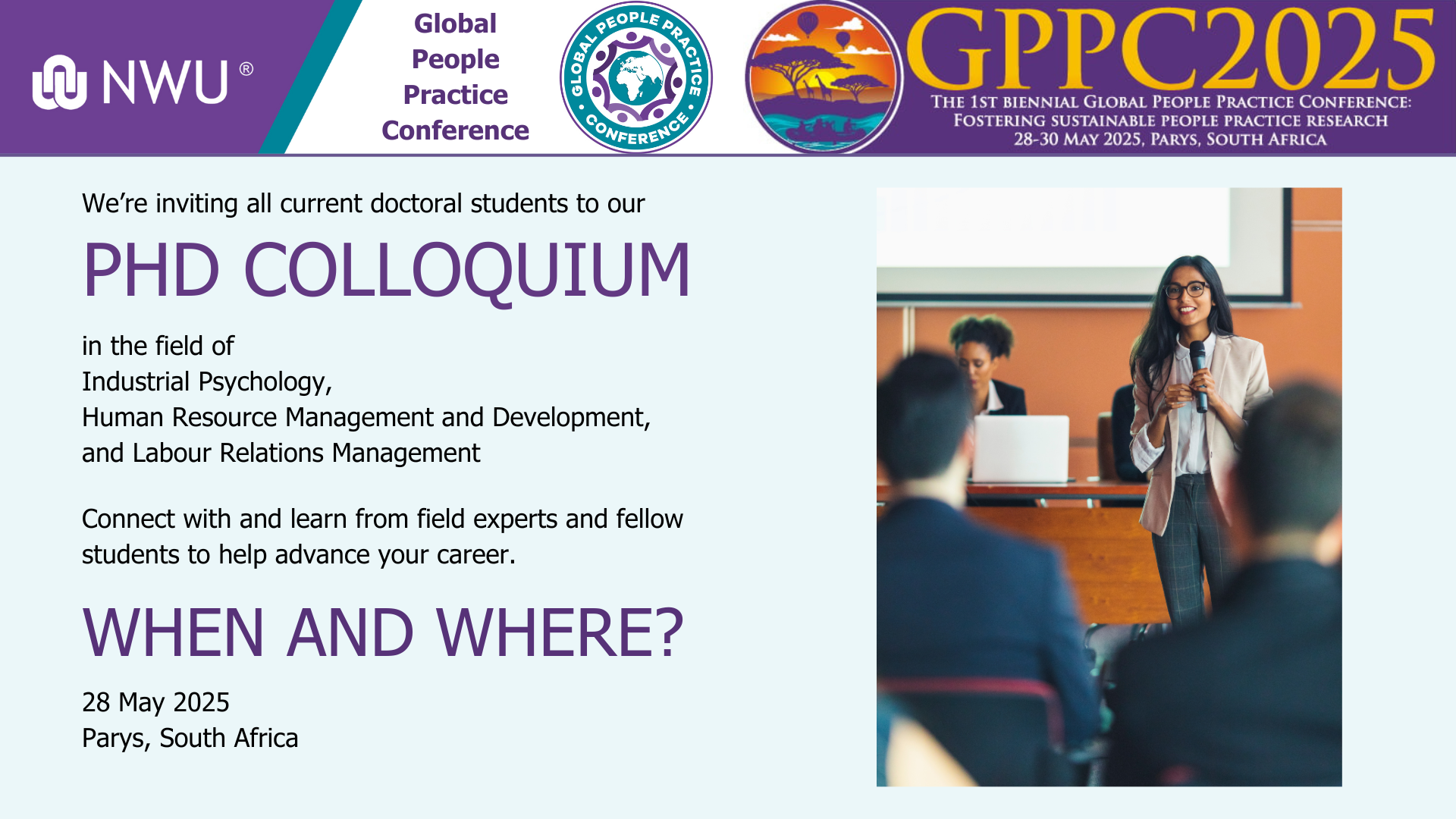
We’re inviting all current doctoral students to join us for the GPPC2025 PhD Colloquium on Wednesday, 28 May 2025 – just 14 weeks away!
🎓 PhD Colloquium Organiser: Dr Neil Barnard (Barnard.Neil@nwu.ac.za)
🤝 Mentorship Panel: Dr Barnard is assembling a dynamic team of mentors, including Prof Elaine Farndale who is a keynote speaker at GPP2025. Stay tuned for more updates on our website!
This PhD Colloquium (as part of the Global People Practice Conference) is designed for doctoral students in the field of Industrial Psychology, Human Resource Management and Development, and Labour Relations Management, looking to connect with and learn from field experts and fellow students to help advance their career. The conference and this colloquium are in person at Khaya iBhubesi, Parys, Free State.
Don’t miss this opportunity to connect, learn, and grow with leading experts and fellow researchers. Secure your spot today!
🔗 https://commerce.nwu.ac.za/global-people-practice-conference/phd-colloquium-abstract-submissions
#GPPC2025 #PhDColloquium #ResearchJourney #AcademicNetworking #Mentorship #PhDLife #ElaineFarndale #NeilBarnard #AcademicConference #CountdownToGPPC #GlobalResearch
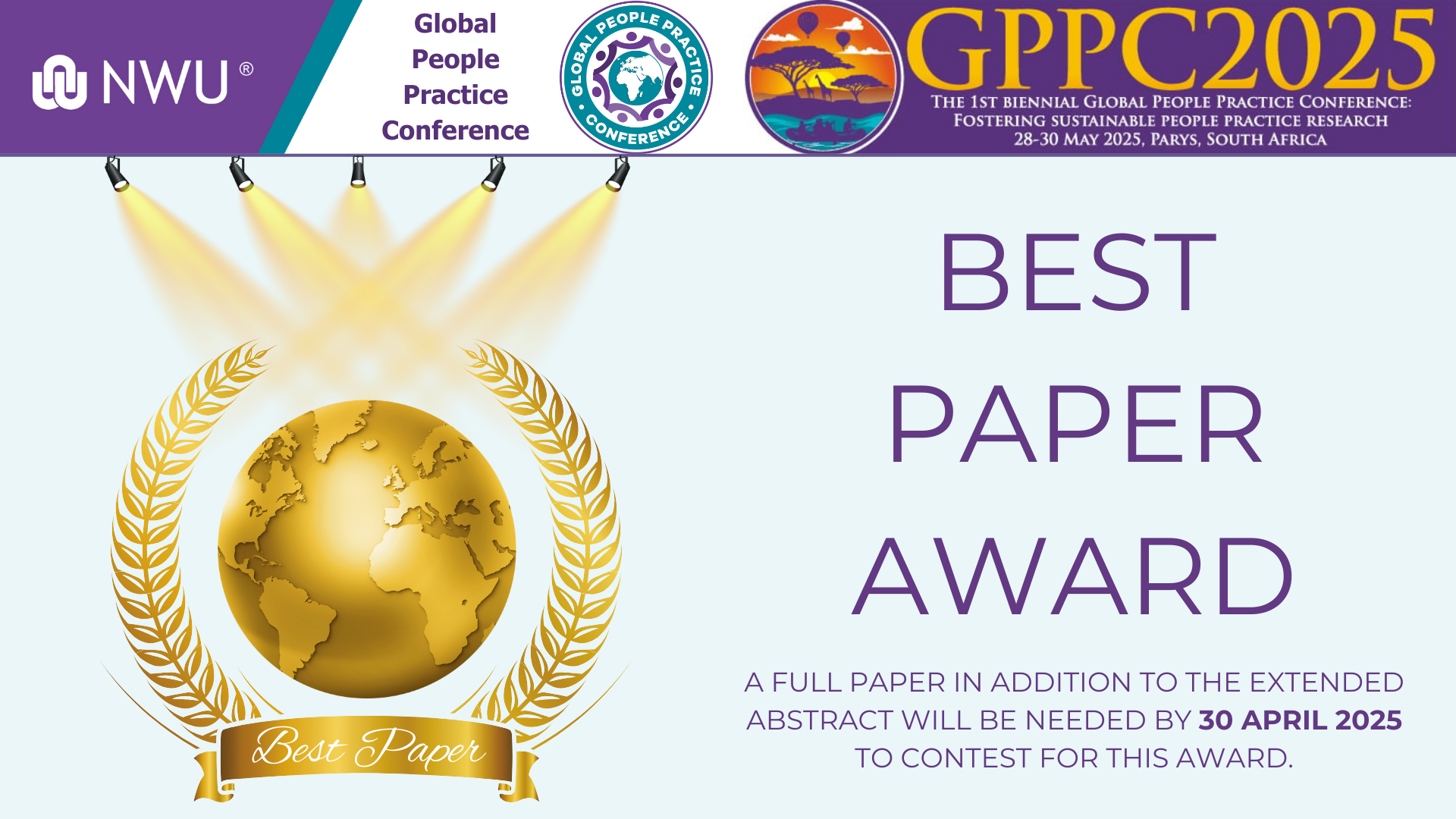
Submit Your Full Paper for the GPPC2025 Best Paper Award!
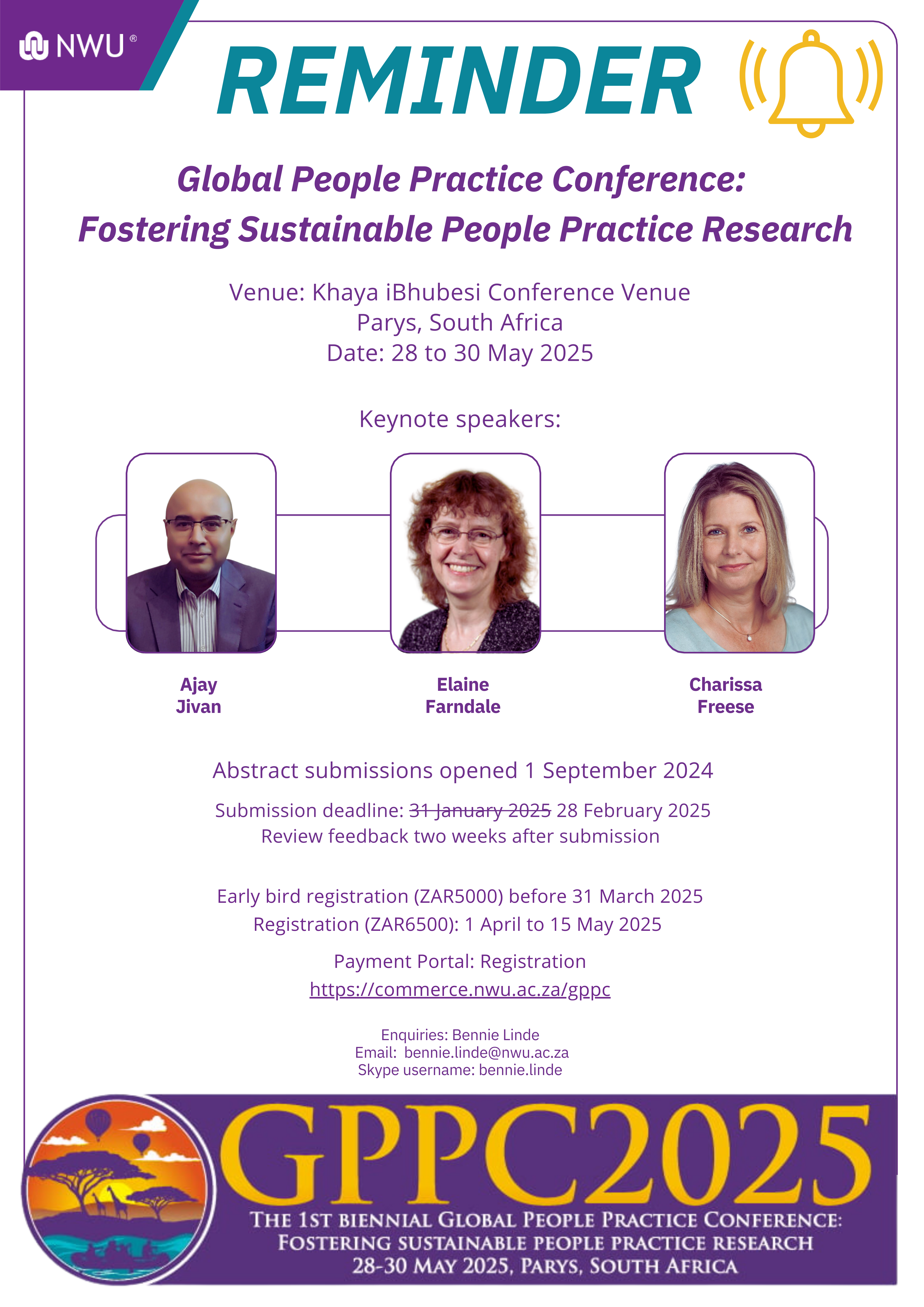
To all academics who submitted abstracts - it's time to take your research to the next level! 🎓✍️
📅 Deadline: 30 April 2025
Submit your full paper to compete for the prestigious Best Paper Award at GPPC2025!
Winners gain recognition, potential publication opportunities, and the chance to be highlighted among leading experts in the field.
🎟️ Early Bird Registration Ends 31 March 2025!
Secure your spot at GPPC2025 at a discounted rate - don’t miss out on savings!
📨 Submit your paper & register today: https://commerce.nwu.ac.za/global-people-practice-conference/gppc-registration
#GPPC2025 #AcademicExcellence #BestPaperAward #ResearchMatters #EarlyBirdRegistration
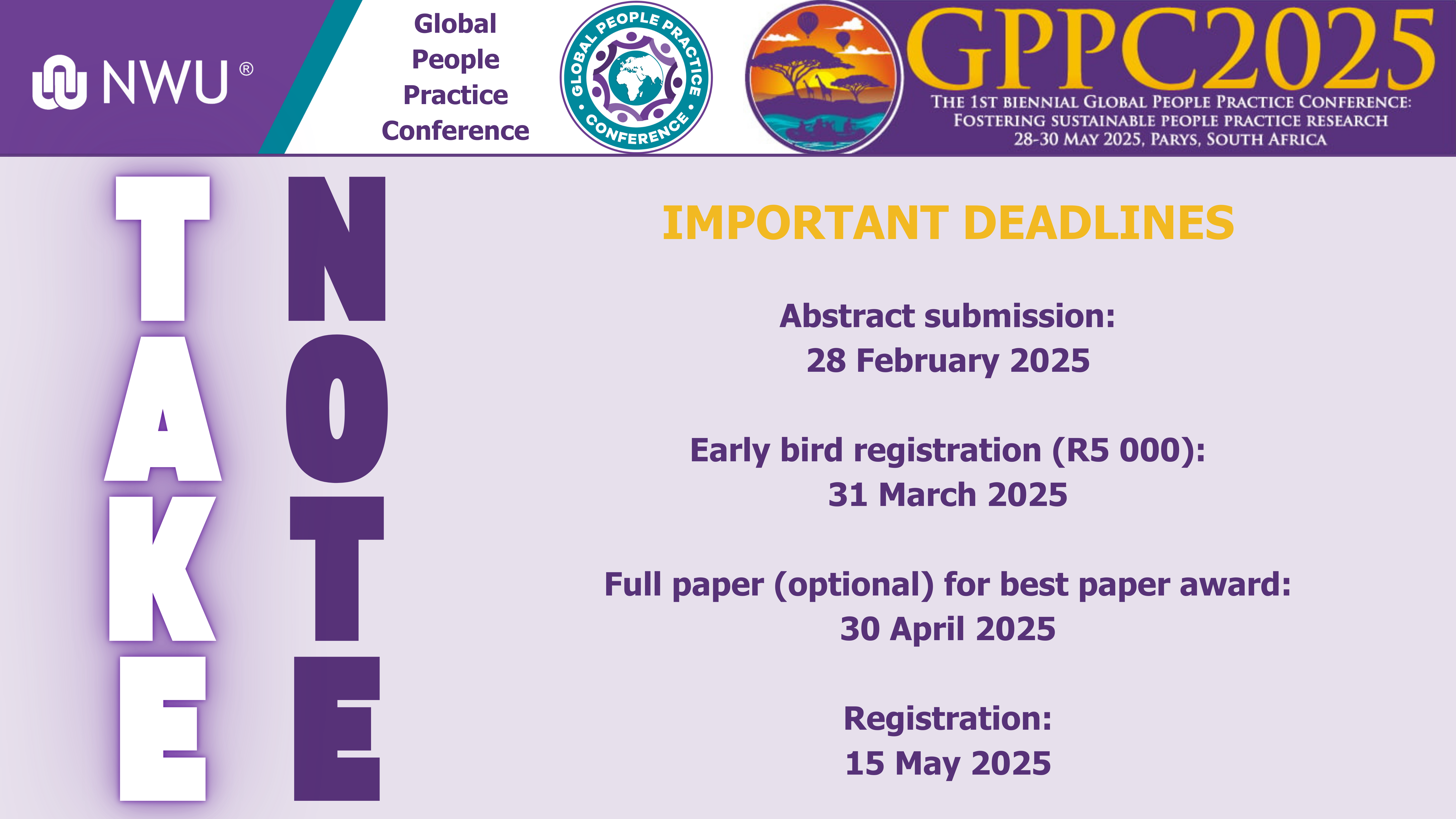
Upcoming People Practices Conference in South Africa 2025 - Key Deadlines!
The Global People Practice Conference 2025 (GPPC2025) is bringing together top researchers, HR practitioners, and academics to explore the future of sustainable people practices. Don’t miss your chance to be part of this exciting event!
🔹 Key Deadlines to Keep in Mind:
📌 Abstract Submission: 28 February 2025
📌 Early Bird Registration (R5 000): 31 March 2025
📌 Full Paper (optional) for Best Paper Award: 30 April 2025
📌 Registration Deadline: 15 May 2025
📅 Conference Dates: 28 - 30 May 2025
📍 Location: Khaya iBhubesi, Parys, South Africa
🚀 Why Attend?
✅ Present your research and contribute to global HR discussions
✅ Engage with leading experts in Industrial Psychology, HR, and Labour Relations
✅ Network with like-minded professionals and expand your academic reach
🔗 Secure your spot today: Register here 👉 GPPC Registration | Commerce
#GPPC2025 #HRResearch #PeoplePractices #AcademicOpportunities #SustainableEmployment #GlobalHR #Networking #UpcomingHumanResourcesConference2025
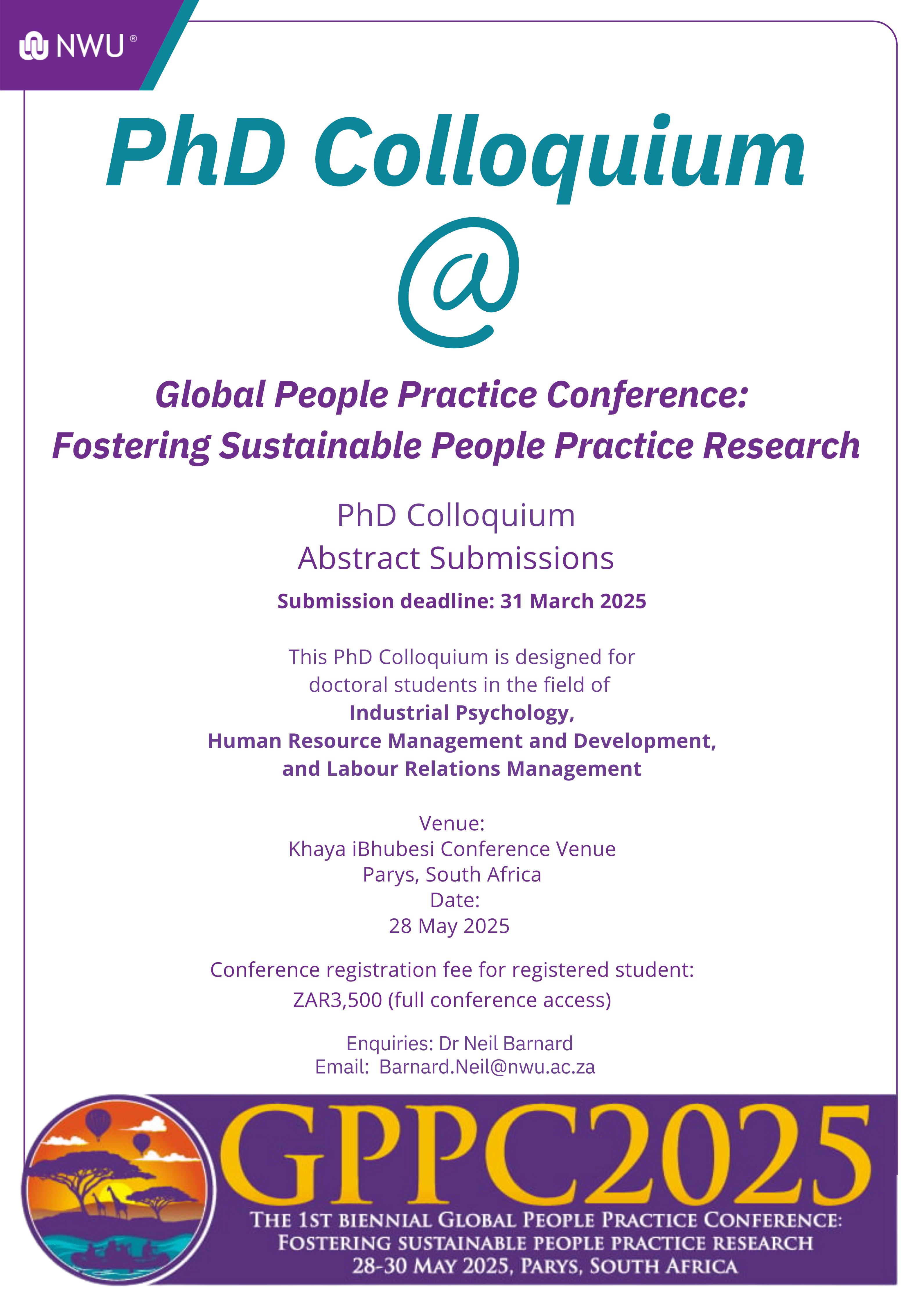
GPPC2025 PhD Colloquium
Shape Your Research Journey at GPPC2025: PhD Colloquium Call for Abstracts
The GPPC2025 PhD Colloquium invites current doctoral students to engage with a network of scholars and peers in Industrial Psychology, Human Resource Management and Development, and Labour Relations Management.
This dedicated session provides a platform to discuss research, receive valuable feedback, and build connections that support academic and professional growth.
PhD students are encouraged to submit extended abstracts (750–1,000 words) outlining their theoretical framework, research design, and project development. Accepted abstracts will be included in the digital conference programme.
Join the conversation, share your insights, and take part in a collaborative space designed to support emerging researchers. Abstract submissions close 31 March 2025. For more details, contact Dr Neil Barnard on Barnard.Neil@nwu.ac.za
Follow the link for more about the PhD Colloquium abstract submissions and preliminary programme
👉 PhD Colloquium abstract submissions | Commerce
GPPC2025 PhDColloquium PhDResearch
GPPC2025 Global People Practice Conference
About GPPC2025
Hosted by the School of Industrial Psychology and Human Resource Management, North-West University, South Africa
Conference theme: Fostering sustainable people practice research
People practice focuses on the processes and approaches used across the employee lifecycle, including the strategies and tactics involved in attracting, recruiting, onboarding, developing, and retaining employees within fair and meaningful employment. For this conference we invite academics and practitioners to converse on such practices that foster sustainable employment from a global perspective. Various approaches to people practices are necessary for us to understand and contribute to sustainable employment, including human resource management and development, employment relations, as well as industrial and organisational psychology. These various approaches to understand people in the workplace assist us to understand and contribute to the society.
Accordingly, we would like to invite you to join us at Khaya iBhubesi in Parys, South Africa, for the first biennial Global People Practice Conference organised by the School of Industrial Psychology and HRM of the North-West University. The conference will feature presentations, discussions, and networking opportunities. We seek academic conversations with paper submissions and presentations that will broaden our understanding and foster sustainable people practices. To this end, we invite submissions that cover conceptual, theoretical, and empirical investigations that adopt a broad range of methodologies and highlight fair, equal and sustainable people practices.
Keynote speakers
Our three keynote speakers will be:
Dr Ajay Jivan (South African Board of People Practice, South Africa)
Professor Elaine Farndale (The Pennsylvania State University, USA)
Professor Charissa Freese (TIAS School of Business and Society & Tilburg University, Netherlands)
Deadlines:
Abstract submission: 28 February 2025
Early bird registration (R5 000): 31 March 2025
Full paper (optional) for best paper award: 30 April 2025
Registration: 15 May 2025
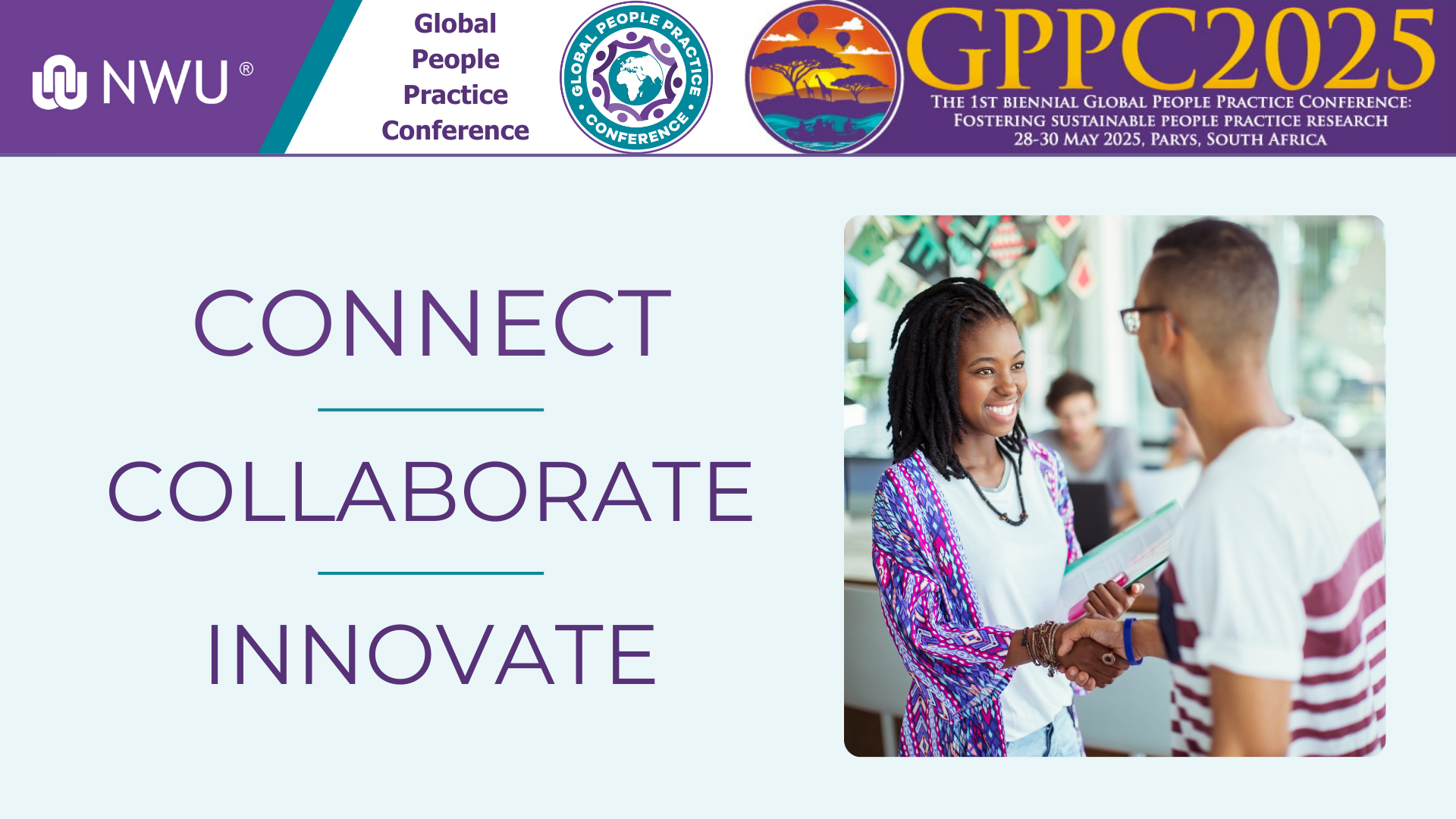
Connect. Collaborate. Innovate.
At GPPC2025, networking is more than just a handshake - it’s a gateway to groundbreaking collaborations between academia and industry.
Whether you're in corporate-funded research, private sector R&D, or HR leadership, this is your opportunity to engage with top researchers, HR experts, and business innovators shaping the future of sustainable people practices.
Why attend?
✅ Gain insights from leading minds in HR, employment relations, and organisational psychology
✅ Discover practical, research-driven strategies for talent management and workplace sustainability
✅ Build valuable partnerships that drive real-world impact in your organisation
Be part of the conversation that bridges research and industry!
Register today: https://commerce.nwu.ac.za/global-people-practice-conference/gppc-registration
📅 28 - 30 May 2025 | 📍 Khaya iBhubesi, Parys, South Africa
#GPPC2025 #HRInnovation #CorporateResearch #SustainablePeoplePractices #NetworkingForImpact #IndustryCollaboration #FutureOfWork
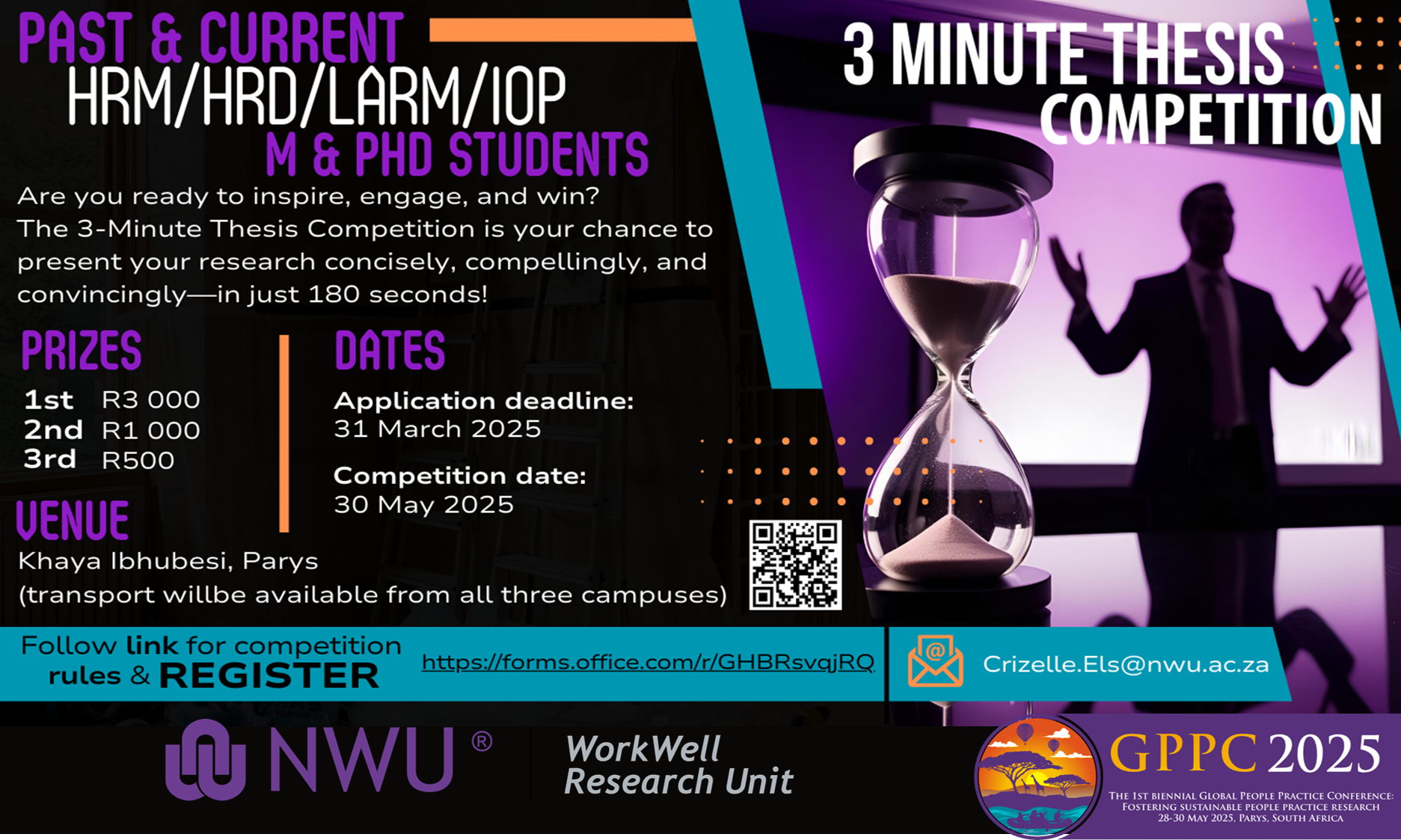
GPPC2025 3-Minute Thesis Competition: Pitch Your Research & Win!
Are you ready to showcase your research in just three minutes? 🎤✨
The GPPC2025 3-Minute Thesis Competition is calling past and current HRM, HRD, LARM, and IOP Master’s and PhD students to present their research in a concisely, compellingly and convincingly way.
This is your chance to impress leading researchers, industry experts, and innovators at GPPC2025 in Parys on 30 May 2025 – and walk away with a cash prize!
🏆 Prizes
1st Place: R3,000
2nd Place: R1,000
3rd Place: R500
How to Enter?
1️⃣ Create a 3-minute video presenting your thesis research in a way that is engaging, creative, and easy to understand.
2️⃣ Show us why your research matters – make it exciting, make it relatable!
3️⃣ Submit your video to https://forms.office.com/r/GHBRsvqjRQ before 31 March 2025.
📅 Key Dates
Application Deadline: 31 March 2025
Competition Date: 30 May 2025
Venue: Khaya iBhubesi, Parys
Transport will be arranged from all three NWU campuses (Mahikeng, Potchefstroom & Vanderbijlpark).
🌍 Whether your research is tackling real-world challenges, pushing boundaries, or uncovering new insights, this is your chance to step into the spotlight and make an impact!
📢 Don’t miss out on this opportunity to connect, compete, and be recognized!
🔗 Want to know more about GPPC2025? Visit 👉 https://commerce.nwu.ac.za/gppc
#GPPC2025 #3MinuteThesis #MastersResearch #PhDLife #AcademicOpportunities #ThesisPitch #NWUStudents #NWUResearch #FutureLeaders #HRM #HRD #LARM #IOP